
0
Fund 1
Fund 2
Fund 3
Fund 4
Contact us
Contact Nuveen
Thank You
Thank you for your message. We will contact you shortly.
While many investment products provide a consistent income stream, the payments are often fixed and don't increase over time. Conversely, companies that are committed to rewarding shareholders through increasing dividend payments can provide investors with the potential for a growing income stream and stock price appreciation.
By being overly focused on current dividend yield, investors may overlook a wide universe of companies with attractive fundamentals and potential for impressive dividend growth in the future. We believe investors are well advised to approach dividend-oriented portfolios from an integrated, total return perspective considering both income and capital gains over the long-term.
Current yield: The basics
Current yield is a snapshot in time of a company’s annual dividends per share divided by its current stock price per share. The resulting data from multiple securities can then be averaged to arrive at the overall current yield of a portfolio. While we view current yield as an important variable to consider, we believe it has become far too common to rely on it as a sole or even a primary measure of a dividend-oriented portfolio. Part of this trend may be driven by simplicity; current yield is a data point that is readily available among the information tools used today. As is so often the situation, however, this simplicity can come at a cost—in this case, potentially lower long-term total return.
Current yield = Current annual dividend per share
Current stock price
The key danger in overly focusing on current yield, in our view, is that investors can be led to overlook companies that have enjoyed such success that they have been rewarded with stock price increases that equal or outstrip the growth of their rising dividend. That is to say, if the denominator of a company’s stock price appreciates at an equivalent or faster rate than the numerator of its dividend, such a situation may put downward pressure on that company’s current dividend yield, even if the dividend is growing respectably. We find it detrimental to eliminate positions from a portfolio or exclude companies from research coverage merely due to low current yield. By placing too much emphasis on current yield, we feel total return over the long-term could be compromised due to comparatively weak capital gains.
Yield-at-cost: Providing some perspective
Given our long-term approach to investing and our partiality to companies with consistent dividend growth, we believe a more effective way to analyze yield is not by utilizing the current yield but rather the “yield-at-cost” of a portfolio. Yield-at-cost divides a company’s current annual dividend per share by the original cost basis per share at which the company was brought into a portfolio. This calculation takes a company’s dividend growth into account and doesn’t “penalize” a company for stock price appreciation. From our perspective, one of the key insights of a yield-at-cost analysis is that healthy dividend growth may accompany or even lead to stock price appreciation.
Yield-at-cost = Current annual dividend per share
Original cost basis per share
A real-world company example
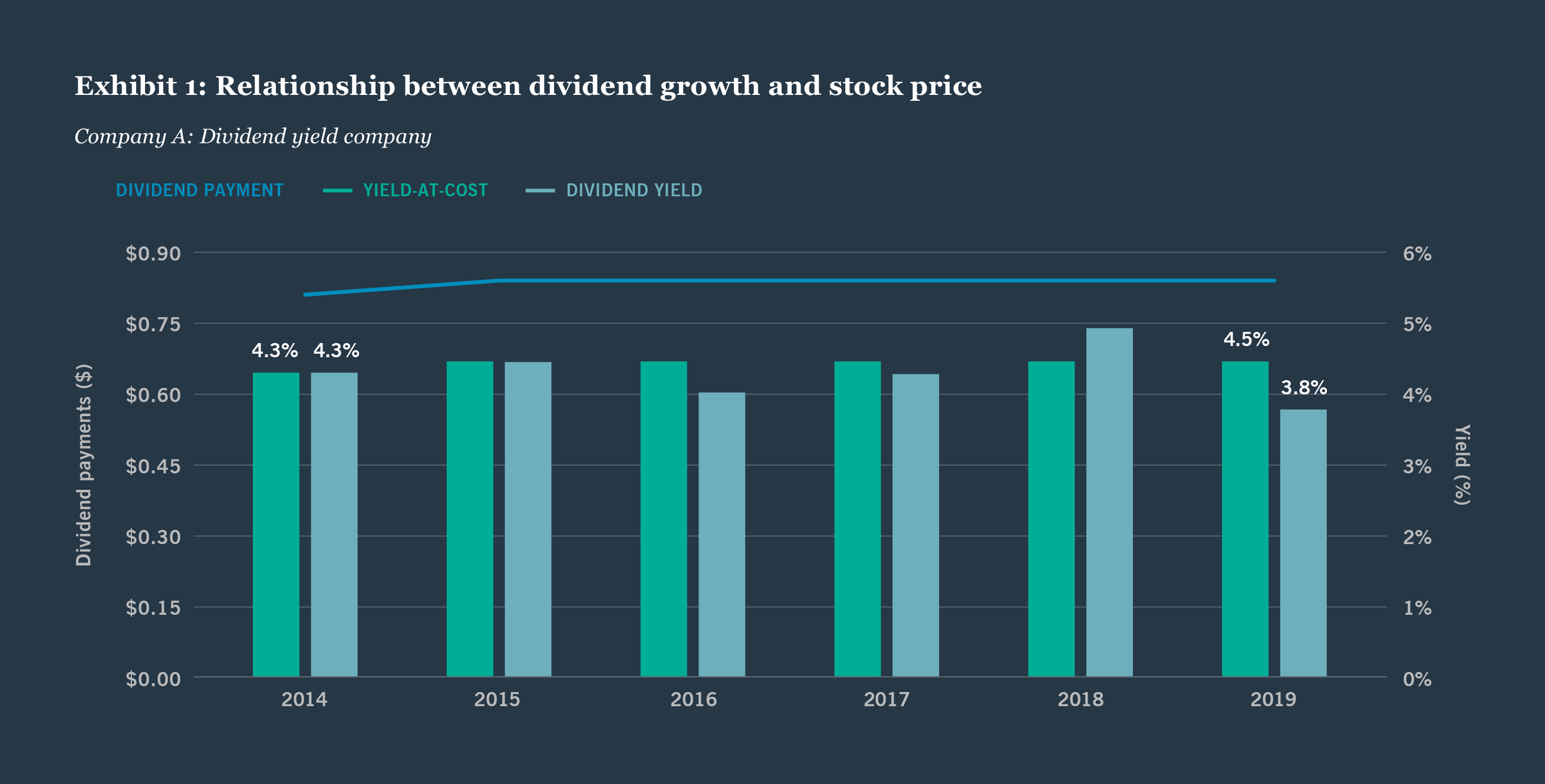
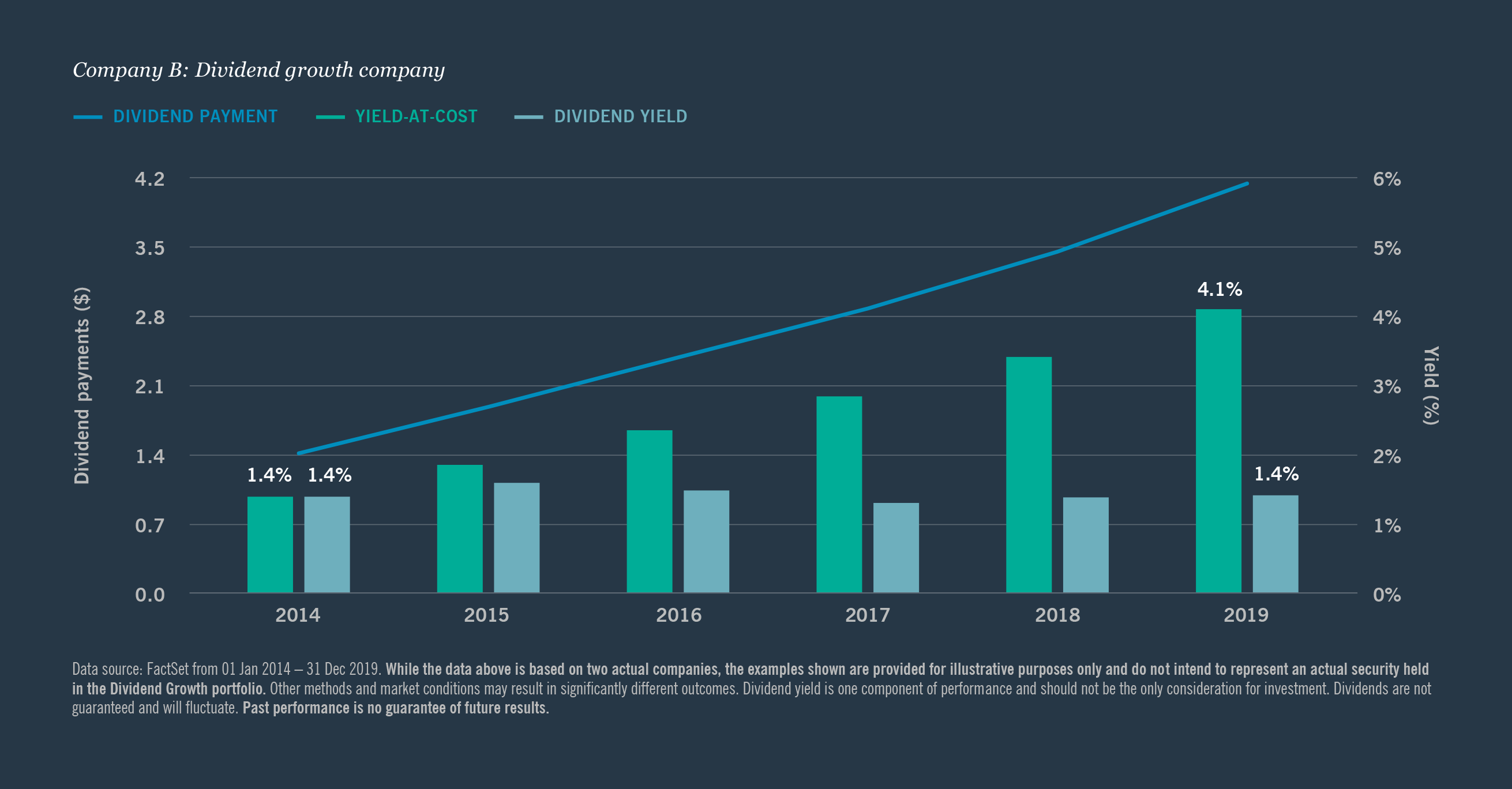
Exhibit 1 chronicles an example of a high-yielding company and a dividend growth company. Company A represents a high-yielding company with minimal dividend growth while Company B represents a relatively low-yielding, but strong dividend growth company.
Company A (dividend yield company): annualized
Company B (dividend yield company): annualized
An investor focused solely on income will likely prefer Company A for its very high yield. While the company may provide an attractive level of current income on an annual basis, the dividends paid out by the company remain static, coinciding with relatively little capital appreciation.
Company B would likely be overlooked by that yield-seeking investor, because its current dividend yield never once surpasses 2%. However, this is not the result of a static dividend payment – in fact, the company increased its dividend by 24% annually since 2014. Its consistently low yield can be attributed to the similarly strong capital appreciation in the company’s stock price, which grew by 24% annually over the same time period.
We believe this example accentuates the limitations of focusing on a company’s yield as a means of security selection and as an analytical measure. A company with a low yet growing dividend may offer an investor greater total return potential due to the strong relationship between dividend growth and price appreciation.
Santa Barbara’s approach to applying yield-at-cost
We believe a yield-at-cost perspective can help add value for our clients by providing us with tools to retroactively evaluate companies in the portfolio that may be growing dividends while simultaneously appreciating in value.
The chart in Exhibit 2 shows a generally widening gap over time between the current portfolio yield and the portfolio yield-at-cost of the Dividend Growth portfolio. We believe this example illustrates a portfolio that has benefited over time from both dividend growth and capital appreciation. We find the portfolio’s yield remained competitive throughout this period, but by avoiding what we would view as overreaching for yield, we were able to maintain exposure to select companies that benefited from stock price gains.
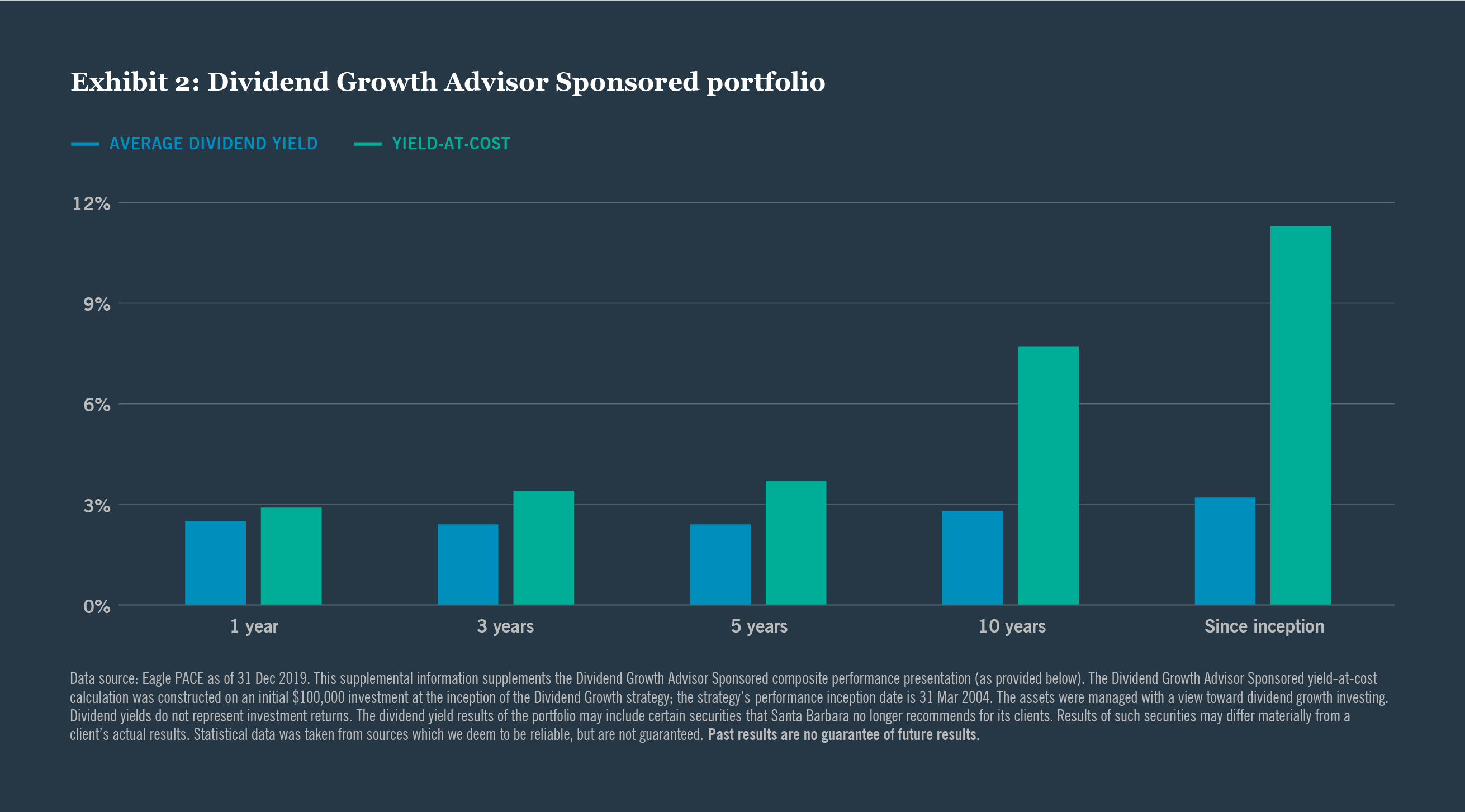
A rising yield at cost results from a company growing its dividend – not only providing the potential for higher income in the future, but companies that consistently increase their dividends historically have strong performance track records.
Conclusion
Ultimately, we believe the increase or decrease in a security’s current yield shouldn’t be of chief importance; rather, we believe emphasis should be placed on the total return that has been produced as a result of owning high-quality companies that possess the financial flexibility to increase dividends while also appreciating in value with time. We view a yield-at-cost perspective as a much more helpful framework for determining portfolio success than simply looking at current yield. In our view, “seeing the whole picture” in this manner is likely to provide real value for clients over the long-term.
Related articles

Unprecedented monetary and fiscal stimulus – combined with signs of an economic recovery as lockdowns eased globally – triggered a rapid rebound in risk assets.
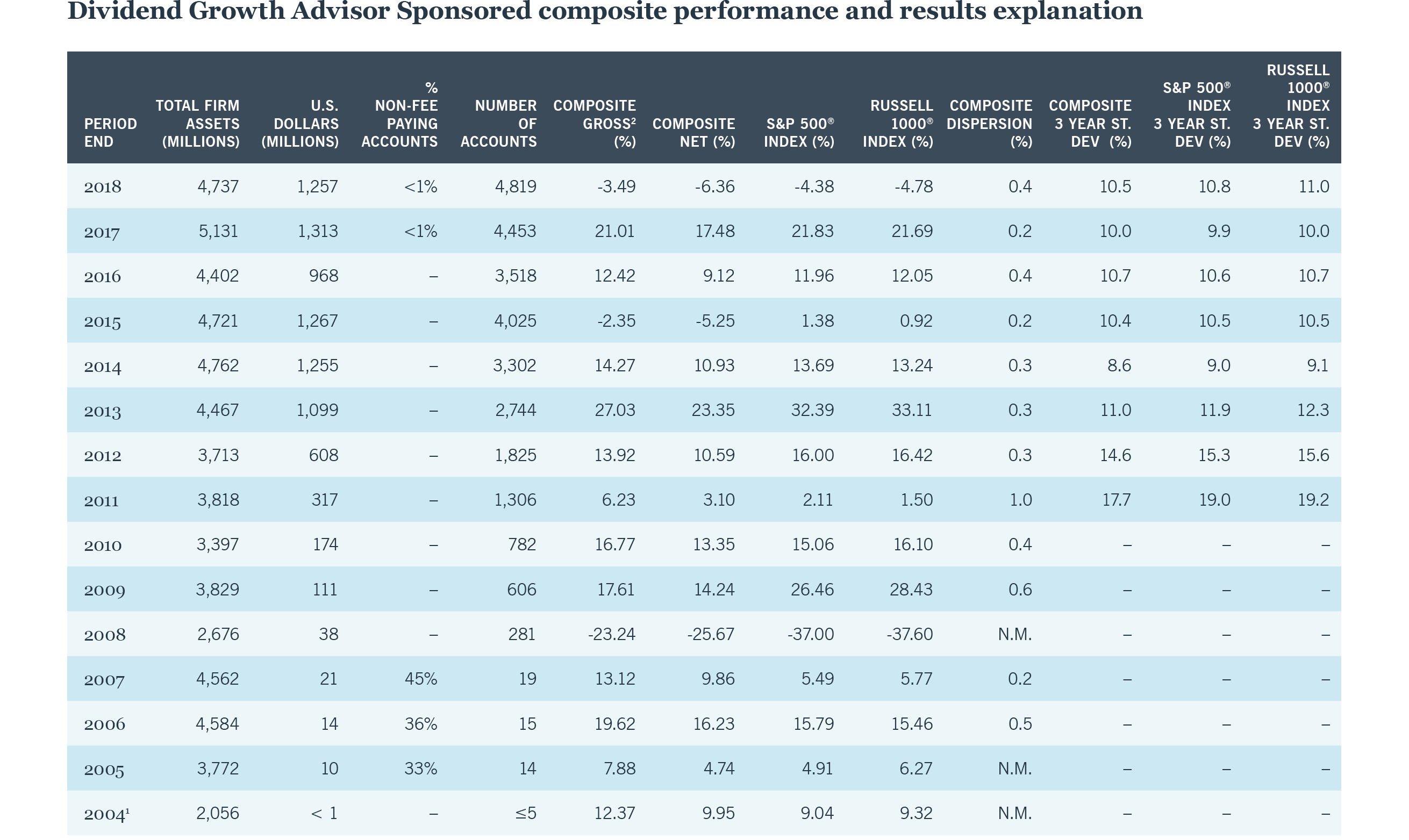
1 Results shown for the year 2004 represent partial period performance from 01 Apr 2004 through 31 Dec 2004.
2 Beginning 01 Apr 2008, “pure” gross returns do not reflect the deduction of any expenses including transaction costs and are supplemental to net returns.
N.M. – Information is not statistically meaningful due to the composite including five or fewer portfolios for the entire year.
Dividend Growth Advisor Sponsored composite incepted on 01 Apr 2004; the composite creation date is April 2008. The composite contains all fully discretionary Dividend Growth Advisor Sponsored accounts. The strategy primarily invests in dividend-paying common and preferred stocks with the potential for future dividend growth and capital appreciation. The strategy may invest in small-, mid- and large-cap companies. Dividend Growth generally invests in U.S. companies, although investment in non-U.S. companies is permitted in the form of ADRs. For comparison purposes, the composite is measured against the S&P 500® and Russell 1000 Indices.
The firm, Santa Barbara Asset Management, LLC is a registered investment adviser and subsidiary of Nuveen, LLC. Registration does not imply a certain level of skill or training. The firm maintains a complete list and description of composites, which is available upon request.
Santa Barbara Asset Management, LLC claims compliance with the Global Investment Performance Standards (GIPS®) and has prepared and presented this report in compliance with the GIPS® standards. Santa Barbara Asset Management, LLC has been independently verified for the periods 01 Jul 1988 through 31 Dec 2018. The last firm verification was performed by ACA Performance Services, LLC.
Verification assesses whether (1) the firm has complied with all the composite construction requirements of the GIPS® standards on a firm-wide basis and (2) the firm's policies and procedures are designed to calculate and present performance in compliance with the GIPS® standards. The Dividend Growth Advisor Sponsored composite has been examined for the periods 01 Apr 2004 to 31 Dec 2018. The verification and performance examination reports are available upon request.
Results are based on fully discretionary accounts under management, including accounts no longer with the firm. Effective 01 Jan 2012, Santa Barbara Asset Management, LLC retroactively redefined discretionary assets for GIPS purposes; Unified Managed Account (UMA) assets are excluded from total firm assets. Effective November 2016, $0.5 billion in discretionary assets converted to UMA assets. As of 31 Dec 2018, UMA assets were approximately $6.9 billion.
The U.S. Dollar is the currency used to express performance. Returns are presented gross and net of fees and include the reinvestment of all income. Accounts in the composite will pay a bundled wrap fee based on a percentage of assets under management. Other than portfolio management, the bundled wrap fee includes brokerage commissions, consulting services, custodial services and other expenses that may be associated with the management of the account.
The highest wrap fee may change over time. Net of fee performance was calculated using the highest applicable annual fee of 3.00%. For the period 01 Apr 2010 forward, net of fee returns have been calculated by reducing the “pure” gross of fee return using the highest applicable fee on a monthly basis. For the period from 01 Apr 2008 to 01 Apr 2010, net of fee returns were calculated by reducing the “pure” gross return using the highest applicable fee on a quarterly basis. Performance results prior to 01 Apr 2008 are that of the Dividend Growth Composite and are net of transaction costs. Prior to 01 Apr 2008 net of fee returns were calculated by reducing the gross return using the highest applicable fee on a quarterly basis.
The wrap program may charge an all-inclusive fee as high as 3.00%. Wrap fees are available upon request from the respective wrap sponsor. Actual investment advisory fees incurred by clients may vary.
Internal dispersion is calculated using the asset-weighted standard deviation of the annual “pure” gross returns of all portfolios included in the Composite for the entire year.
Bundle fee portfolios make up 0% of composite assets prior to 31 Mar 2008 and 100% of composite assets beginning 01 Apr 2008.
The Composite performance is presented net of non-U.S. taxes withheld on dividends, interest income, and capital gains.
Composite returns represent investors domiciled primarily in the United States. Policies for valuing portfolios, calculating performance, and preparing compliant presentations are available upon request.
Prior to 01 Apr 2006, balanced portfolio segments were included in this composite. Cash was allocated to equity segments using a set percentage. As of 31 Dec 2005, 18% of composite assets are comprised of carve-out segments.
The returns are compared to the S&P 500® Index, which is a market-capitalization weighted index. The S&P 500® Index is a widely used gauge of large-cap U.S. equities. The S&P 500® Index includes 500 leading companies and captures approximately 80% coverage of available market capitalization. The volatility of the Index may be materially different from that of Dividend Growth strategy. In addition, the holdings in the Dividend Growth strategy may differ significantly from the securities that comprise the Index.
The secondary benchmark was changed in the 3rd quarter of 2008 from the Dow Jones US Select Dividend Index to the Russell 1000® Index. The change was made after determining that the Russell 1000® Index was a better representation of the Dividend Growth strategy. The Russell 1000® Index measures the performance of the large-cap segment of the U.S. equity universe. The Index is comprised of approximately 1000® of the largest companies in the Russell 3000® based on a combination of market cap and current index membership. Benchmark returns are not covered by the reports of independent verifiers.
The Indexes have not been selected to represent appropriate benchmarks to compare to the Dividend Growth strategy performance, but rather are disclosed to allow for comparison of Dividend Growth strategy performance to that of well-known and widely recognized Indexes.
Effective 10 Jun 2019, David S. Park and David A. Chalupnik are the portfolio managers of the Dividend Growth Advisor Sponsored strategy, both replacing James R. Boothe, the prior portfolio manager. Mr. Boothe is no longer with the firm.
Past performance is not indicative of future results. Inherent in any investment is the possibility of loss.
Glossary
Dividend yield: For a company’s stock, the ratio of the dividends paid out by the company each year per share to the share’s current market price.
Dividend growth rate: Represents the percentage increase in the dividend payment since purchase.
Risks and other important considerations
The statements contained herein are based upon the opinions of Santa Barbara Asset Management and the data available at the time of printing this report. Past performance is no guarantee of future results and there is no assurance that any predicted results will actually occur.
All investments carry a certain degree of risk, including possible loss of principal, and there is no assurance that an investment will provide positive performance over any period of time. Equity investments are subject to market risk or the risk that stocks will decline in response to such factors as adverse company news or industry developments or a general economic decline. Dividend yield is one component of performance and should not be the only consideration for investment. Dividends are not guaranteed and will fluctuate.
All information used reflects the most current data available. The information contained in this report has been taken from statistical services and other sources, which we believe is reliable, but not guaranteed for accuracy or completeness. Since no one manager is suitable for all types of investors, it is important to review investment objectives, risk tolerance, tax liability and liquidity needs before choosing a suitable investment style or manager.
Santa Barbara Asset Management, LLC, is a registered investment adviser and an affiliate of Nuveen, LLC.

Contact us
Financial professionals
Individual investors
You are on the site for: Financial Professionals and Individual Investors. You can switch to the site for: Institutional Investors or Global Investors
Please be advised, this content is restricted to financial professional access only.
Login or register as a financial professional to gain access to this information.
or
Not registered yet? Register
You are about to access our website for visitors outside of the United States.
You're about to access test site
You are about to access our website for Nuveen Global Cities REIT
You are leaving the Nuveen website.
You are leaving the Nuveen website and going to the website of the MI 529 Advisor Plan, distributed by Nuveen Securities, LLC.The Nuveen website for institutional investors is available for you.
You are about to access our website for visitors outside of the United States.
You are about to access our website for Nuveen Churchill Private Capital Income Fund (“NC - PCAP”)
